
The True Cost of a Bad Hire Is Not Salary Loss. It’s Hiring System Failure
Recruitment Agencies Are Processing More Candidates Than Ever and Trusting Their Hiring Decisions Less
A recruitment agency in India receives over 1,200 applications for a mid-level engineering role.
Three recruiters are managing six active client mandates simultaneously.
The client expects shortlisted candidates within 72 hours.
By the end of the week:
recruiters are exhausted,
evaluation quality has dropped,
strong resumes were overlooked,
average-fit candidates moved forward,
and two highly qualified candidates already accepted offers elsewhere.
A month later, the placement fails.
The hiring cycle restarts.
Client confidence weakens.
Recruiter bandwidth collapses further.
This is no longer an isolated hiring mistake.
It is becoming a structural recruitment problem across high-volume hiring markets like India, the United States, the United Kingdom, and Southeast Asia.
The problem is no longer attracting candidates.
The real problem is evaluating them reliably at scale.
Most Discussions About the Cost of a Bad Hire Miss the Real Problem
Search online for “cost of a bad hire,” and most articles discuss:
salary waste,
onboarding costs,
training expenses,
or rehiring budgets.
Those costs are real.
But they are also surface-level.
For modern recruitment agencies and hiring teams, the deeper damage happens inside:
evaluation consistency,
recruiter capacity,
hiring confidence,
client trust,
and operational scalability.
According to the U.S. Department of Labor, a bad hire can cost at least 30% of the employee’s first-year earnings.
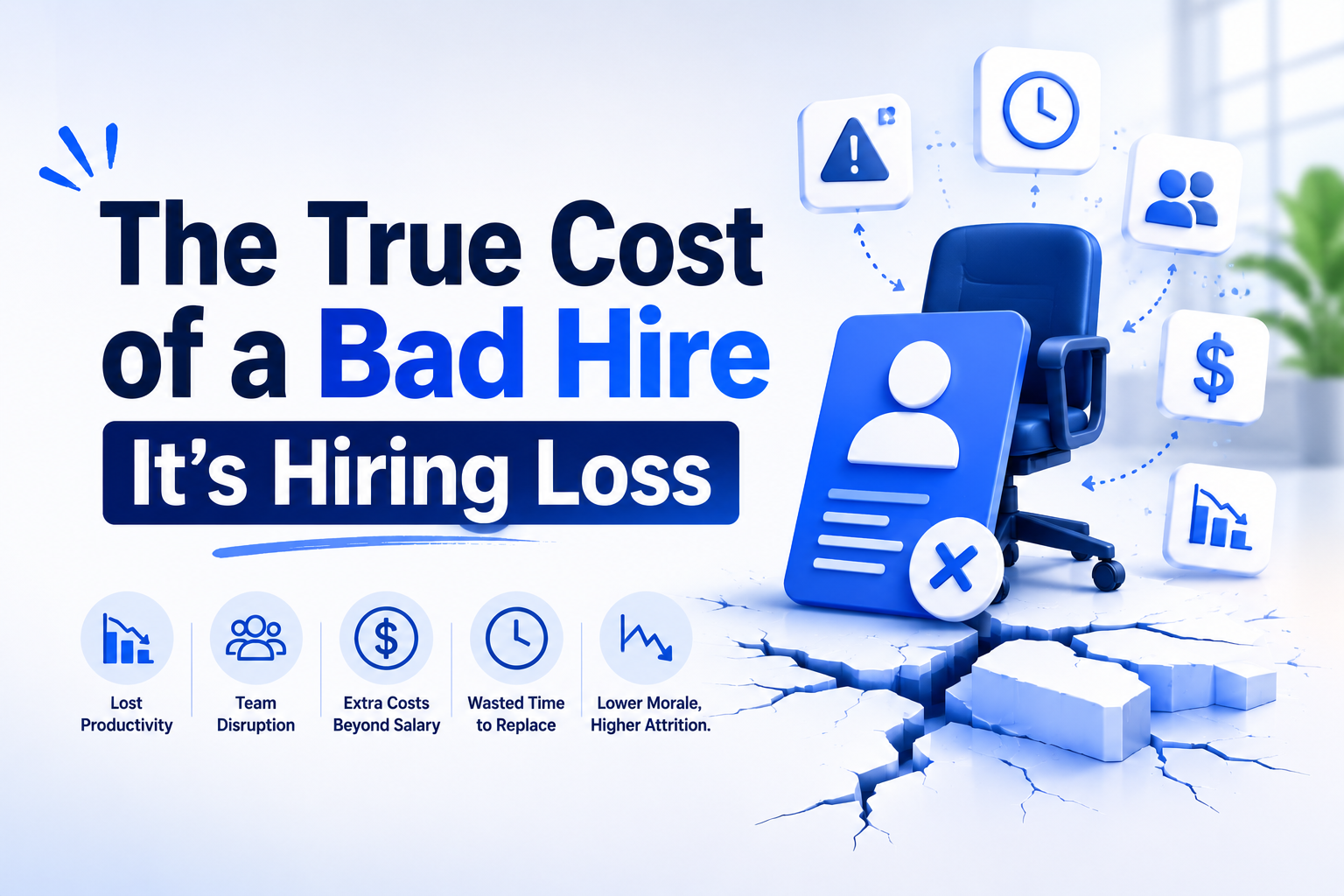
But in modern recruitment environments, the hidden operational costs are often far greater:
delayed placements,
recruiter burnout,
inconsistent shortlists,
candidate dropoff,
replacement hiring cycles,
weaker team performance,
and declining client confidence.
The biggest risk is not one failed employee.
The biggest risk is a hiring system that repeatedly produces inconsistent hiring outcomes under pressure.
Traditional Hiring Systems Were Never Designed for Modern Hiring Volume
This is the structural issue most recruitment teams still underestimate.
Modern hiring environments have changed dramatically.
Application volume has exploded because of:
LinkedIn Easy Apply,
job board saturation,
AI-assisted applications,
and remote hiring expansion.
But most hiring workflows still depend heavily on:
manual resume screening,
fragmented ATS workflows,
keyword filtering,
recruiter-driven evaluation,
and inconsistent interview processes.
That model breaks under scale.
A recruiter reviewing hundreds of resumes daily cannot evaluate every candidate with the same depth and consistency.
Eventually:
attention becomes fragmented,
decision quality declines,
evaluation standards vary,
and hiring becomes increasingly reactive.
This is where bad hires begin forming.
Not because recruiters lack experience.
But because traditional hiring systems were never built for modern recruitment pressure.
Recruiter Burnout Is Quietly Becoming a Hiring Quality Crisis
Recruiter burnout is often treated as a workload problem.
In reality, it is increasingly becoming an evaluation problem.
When recruiters operate under constant pressure to:
screen faster,
shortlist faster,
schedule interviews faster,
and close roles faster,
the quality of hiring decisions naturally becomes unstable..
According to LinkedIn, 76% of hiring professionals say attracting the right candidates remains one of their biggest challenges despite access to recruitment technology.
The Recruitment Industry Does Not Have a Candidate Shortage Anymore
It Has an Evaluation Infrastructure Problem.
Ten years ago, recruitment agencies struggled to generate enough applications.
Today, they struggle to evaluate applications consistently at scale.
Most recruitment technology still focuses heavily on:
candidate tracking,
resume storage,
workflow movement,
and pipeline management.
But modern hiring pressure requires something deeper:
reliable evaluation infrastructure.
Because tracking candidates is not the same as evaluating them intelligently.
This is exactly why many recruitment agencies are beginning to rethink their hiring systems entirely.
Not to replace recruiters.
But to reduce operational overload so recruiters can focus on higher-quality hiring decisions instead of repetitive screening work.
Recruitment Agencies Need More Than ATS Workflows Now
Traditional ATS platforms were built to organize applications.
Modern hiring environments require systems that can help evaluate candidates consistently under scale.
Recruitment agencies increasingly need infrastructure that can:
reduce manual screening dependency,
standardize evaluation quality,
improve shortlist consistency,
reduce recruiter overload,
and help hiring teams make more reliable decisions under pressure.
This is why recruitment teams are beginning to move beyond applicant-tracking systems toward evaluation-first hiring infrastructure designed for modern hiring scale.
Platforms like InterviewGod are helping recruitment teams move beyond fragmented hiring processes by enabling:
scalable candidate evaluation,
structured interview workflows,
intelligent screening systems,
and more consistent hiring decisions at scale.
The goal is not simply faster hiring.
It is reliable evaluation without overwhelming recruiters.
That distinction matters.
Because fast hiring without evaluation consistency only increases the probability of bad hires.
The Future of Recruitment Will Belong to Agencies That Evaluate Better, Not Just Faster
For years, recruitment speed was treated as the biggest competitive advantage.
Today, evaluation quality under scale is becoming far more important.
Because modern hiring environments no longer reward agencies that simply process more resumes.
They reward agencies that:
maintain evaluation consistency,
reduce hiring friction,
identify stronger-fit candidates faster,
and build reliable hiring systems under pressure.
The agencies that continue relying entirely on manual screening and fragmented workflows will increasingly struggle with:
recruiter exhaustion,
inconsistent placements,
slower hiring cycles,
and declining client trust.
The agencies that evolve will build systems capable of scaling evaluation quality itself.
That is where modern recruitment is heading.
Final Thoughts
The real cost of a bad hire is not limited to salary loss or replacement expense.
It is the long-term instability created when hiring systems cannot evaluate reliably at modern scale.
And as application volume continues increasing across markets like India, the United States, and the United Kingdom, recruitment agencies will face growing pressure to:
maintain shortlist quality,
reduce recruiter overload,
improve hiring consistency,
and protect client trust simultaneously.
That challenge cannot be solved through manual screening alone anymore.
It requires a different hiring infrastructure approach.
Modern hiring environments require more than resume tracking and manual shortlisting. They require evaluation systems designed for hiring at scale without sacrificing consistency, recruiter bandwidth, or placement quality.
This is why recruitment teams are increasingly moving beyond traditional ATS workflows toward evaluation-first hiring infrastructure.
InterviewGod helps recruitment agencies reduce recruiter overload, standardize candidate evaluation, and make more reliable hiring decisions under modern hiring pressure.
.
Leeza
InterviewGod