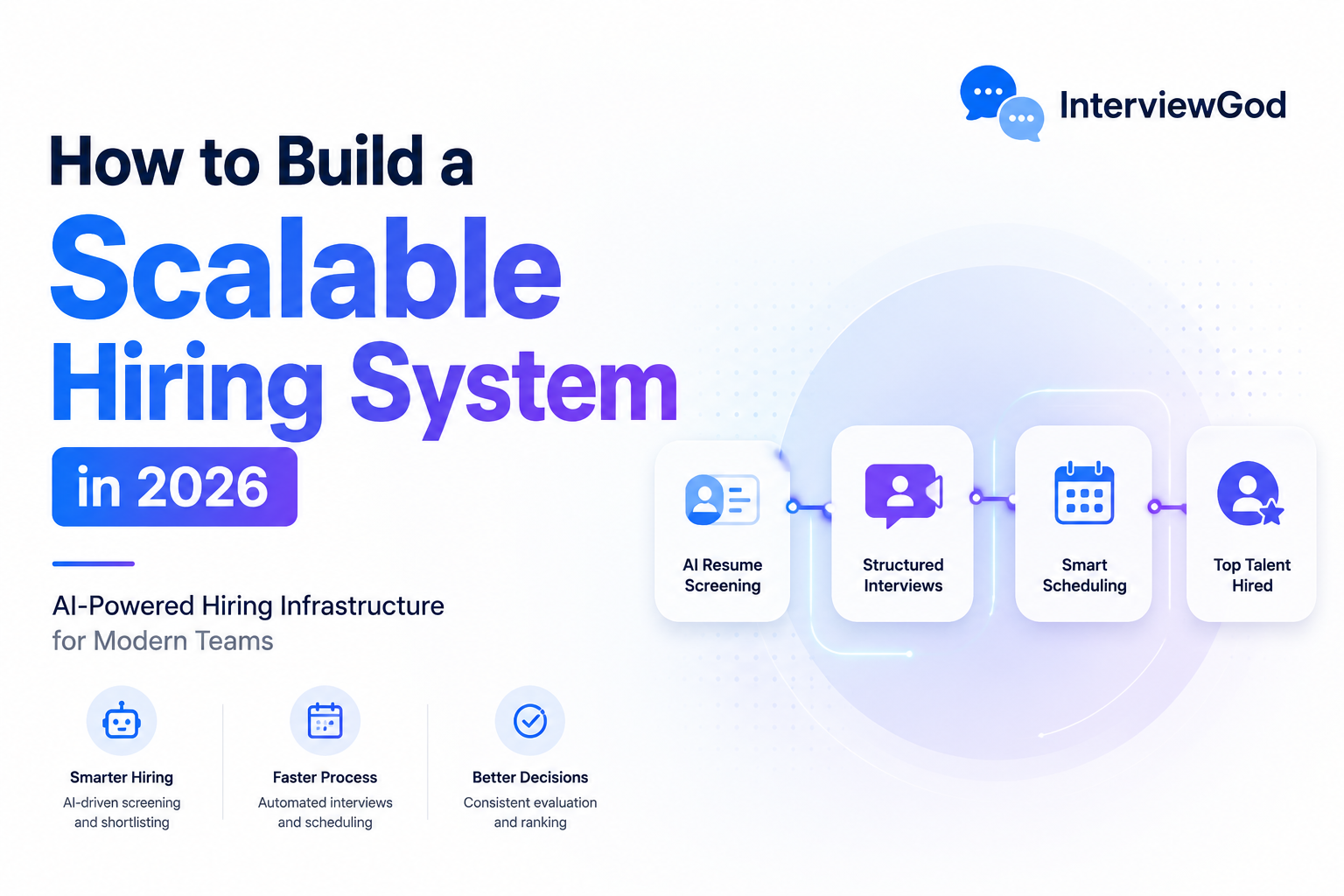
How to Build a Scalable Hiring System in 2026
Here is what a broken hiring system looks like in practice.
A role opens. A job post goes live. Applications flood in. Your recruiter starts reviewing resumes manually, scheduling calls over WhatsApp, chasing candidates across three different tools, and forwarding shortlists over email.
By the time your team reaches a decision, your best candidates are already employed elsewhere.
This is not a recruiter problem. This is a systems problem. And in 2026, it is becoming structurally unsustainable.
Why Most Hiring Processes Break Under Pressure
The majority of hiring processes were designed for a different era when roles attracted 30 to 50 applications and decisions moved at a slower pace.
That baseline no longer exists.
According to Good Time 2026 Hiring Statistics Report, 60% of companies saw time-to-hire increase in 2025 with only 12% managing to reduce it. That means nine out of ten organisations are either slowing down or standing still.
The cause is not lack of effort. It is the absence of a system.
More roles. More applications. Same reactive process. Different results are impossible without changing the structure.
The Three Stages of Hiring Maturity
Before building a scalable system, it helps to understand where most teams currently sit. Hiring maturity moves through three stages:
Reactive Hiring → Structured Hiring → Scalable Hiring
Reactive hiring is role-by-role, ad hoc, dependent on individual effort. It works when you hire twice a year. It collapses when you hire twenty times a quarter.
Structured hiring introduces standardised job briefs, defined criteria, and consistent interview scorecards. It improves quality but still requires high recruiter bandwidth per role.
Scalable hiring combines structure with automation AI screening, automated first-round interviews, self-scheduling, and consistent evaluation criteria applied at volume. The system produces consistent outcomes regardless of how many roles are active simultaneously.
Most organisations currently operate somewhere between reactive and structured. The shift to scalable is the one that determines whether your hiring function can keep pace with business growth.
What "Scalable" Actually Means in Hiring
A scalable hiring system does not mean hiring more recruiters every time application volume spikes. That is a cost spiral, not a solution.
V3 Staffing's 2026 scalable hiring solutions guide frames it precisely: scalable hiring solutions treat recruitment as a repeatable operational workflow rather than a series of urgent tasks. The goal is a structured hiring infrastructure that absorbs higher volume without lowering decision accuracy.
The difference between a scalable and a non-scalable system is structural:
A non-scalable system depends on individual effort one recruiter, one role, one manual process.
A scalable system depends on infrastructure defined criteria, standardised evaluation, automated steps, measurable outcomes.
According to FidForward 2025 hiring strategy report, startups with structured hiring processes are 3x more likely to scale successfully. The infrastructure matters more than the effort applied to it.
The Five Components of a Scalable Hiring System
1. Standardised Role Intake
Before a single application arrives, the role must be defined precisely not just a job description, but a clear set of scoreable criteria that determines what "qualified" means for this specific position.
2. AI-Powered Resume Screening
Manual resume review at volume is operationally unsustainable. According to CareerPlug 2025 Recruiting Metrics Report, based on over 10 million applications, the average recruiter spends just 7.4 seconds manually scanning each resume. Across 600 applications, that still translates to hours of low-signal work before a qualified shortlist exists and the quality of that shortlist depends heavily on who was reviewing resumes at what point in their day.
3. Structured, Automated First-Round Interviews
Scheduling and conducting first-round interviews manually are where most pipelines collapse under volume. GoodTime 2026 Hiring Statistics Report identifies scheduling as the single biggest operational tax on hiring, consuming 38% of recruiter time.
4. Consistent Evaluation Criteria Across Every Role
One of the most overlooked sources of hiring failure is evaluator inconsistency different reviewers applying different standards across different days, different volumes, different levels of fatigue.
5. Automated Scheduling and Pipeline Management
Once a candidate is shortlisted, every day of delay before the next stage is a day in which they are progressing through a competitor's process. Rent a Recruiter's 2026 hiring scalability research shows that AI-powered screening tools can process candidates up to 4x faster, while structured role briefs reduce time-to-offer by 24%.
Where Scalable Hiring Systems Still Fail
Here is something most AI hiring vendors will not tell you: a scalable hiring system, built incorrectly, can fail just as badly as a manual one.
These are the real failure modes:
Poor intake criteria. If the role definition is vague, AI screening will filter for the wrong things at high speed. Garbage in, garbage out faster.
Over-automation without human oversight. Removing human judgment entirely from the process creates blind spots, particularly for roles where contextual fit matters more than explicit criteria.
Bad scorecard design. Evaluation rubrics that are too broad, too generic, or not calibrated for the specific role produce false positives at the shortlist stage which wastes exactly the recruiter time the system was supposed to free up.
No calibration loop. Scalable systems degrade without feedback. If no one is reviewing why certain candidates succeeded or failed post-hire, the system optimises toward the wrong outcomes over time.
The fix is not less automation. It is more structure around the automation. AI amplifies whatever process it sits inside. The process must be worth amplifying.
Why Existing Tools Are Not Solving This
Most ATS platforms automate workflows, not evaluation. They track where candidates are in the pipeline. They do not assess whether candidates belong in it. The distinction matters enormously.
Many AI screening tools available today still rely heavily on keyword parsing flagging resumes that match exact phrases in the job description. That approach filters for candidates who wrote ATS-optimised resumes, not candidates who are the strongest fit for the role.
According to Harvard Business Review Hidden Workers report, 88% of employers believe their hiring systems filter out qualified candidates. The problem is not that companies lack tools. The problem is that the tools they have were built for a different job tracking and organising, not evaluating and ranking.
Scalable hiring requires structured evaluation logic at the screening stage, not just automation of the steps around it. That is the gap most existing tools do not fill.
The Geography Factor: Why One System Does Not Fit All Markets
Building a scalable hiring system also means accounting for how hiring pressure manifests differently across regions.
India: Application volume per role is extremely high. Recruiter-to-applicant ratios are heavily compressed. The primary need is bulk screening automation and faster shortlisting.
US and UK: The pressure skews toward cost efficiency and quality of hire. Recruiters are under pressure to deliver better candidates with leaner teams.
Southeast Asia: Tooling is fragmented and digital adoption is accelerating rapidly. The primary need is workflow consolidation and process standardisation.
As V3 Staffing 2026 guide notes, hiring across countries introduces behavioural and structural differences that go beyond location and without region-specific hiring structure, expansion delays market entry rather than enabling it. A hiring system built only for one market will underperform in another. Scalable infrastructure must be adaptable infrastructure.
What the Best Hiring Teams Are Doing Differently
GoodTime 2026 Hiring Statistics Report is clear on this point: the organisations making meaningful progress are those that have embraced AI-driven decision-making, standardised workflows, and disciplined process improvement not those that simply added more candidates to an already strained system.
The pattern among top-performing teams is consistent:
They define screening criteria before roles open, not while reviewing applications.
They automate the highest-volume, lowest-judgment steps first screening and scheduling.
They run structured interviews at every stage, with scorecards submitted within 24 hours.
They measure time-to-shortlist, not just time-to-hire, because the shortlist is where quality is determined.
They treat hiring as operational infrastructure, not a reactive function triggered by headcount pressure.
Where InterviewGod Fits into This System
This is the problem InterviewGod is purpose-built to solve not a standalone screening tool, not a scheduling add-on, but an end-to-end AI hiring automation platform that provides the evaluation and automation layer most hiring systems are missing.
Here is what that looks like operationally:
AI resume screening ranks every application against your defined role criteria before a human touch the inbox context-aware, not keyword-dependent. Qualified candidates who describe experience differently do not fall through the cracks.
Automated AI interviews conduct structured first-round assessments at scale. Every candidate is evaluated consistently. Your team reviews scored summaries, not raw recordings.
Interview scheduling automation eliminates back-and-forth entirely. Candidates self-book against live availability. Confirmations go automatically.
Consistent criteria-based evaluation means every shortlist is built on the same standards, regardless of which recruiter reviewed which batch on which day.
For a recruitment agency, this means delivering faster shortlists to more clients without expanding the team. For an in-house HR function, it means recruiters spend their time on the candidates who actually matter not the process of getting to them.
Three Things to Do Before Your Next Hire
You do not need to rebuild your entire hiring process at once. Here is where to start:
Define your screening criteria before you post the role.
Audit your current time-to-shortlist.
Automate one step this month.
The Window to Build This Advantage Is Now
According to GoodTime 2026 Hiring Statistics Report, 90% of companies missed their hiring goals in 2025. The teams that did not miss them were not working harder. They were working inside a system designed to produce consistent outcomes regardless of application volume or recruiter bandwidth.
The shift from reactive hiring to system-driven hiring is already underway. The question is not whether to build scalable hiring infrastructure it is how long your team can remain competitive without it.
And that recruiter drowning in 800 applications on a Monday morning? They are not failing because they lack effort or skill. They are failing because the system around them was never designed for modern hiring volume. Building that system is not an upgrade. In 2026, it is the baseline.
See how InterviewGod helps hiring teams build scalable hiring systems with AI-powered screening, structured interviews, and automated scheduling without increasing recruiter workload.
Visit: InterviewGod
Leeza
InterviewGod