The End of Manual Resume Screening: What’s Replacing It in 2026
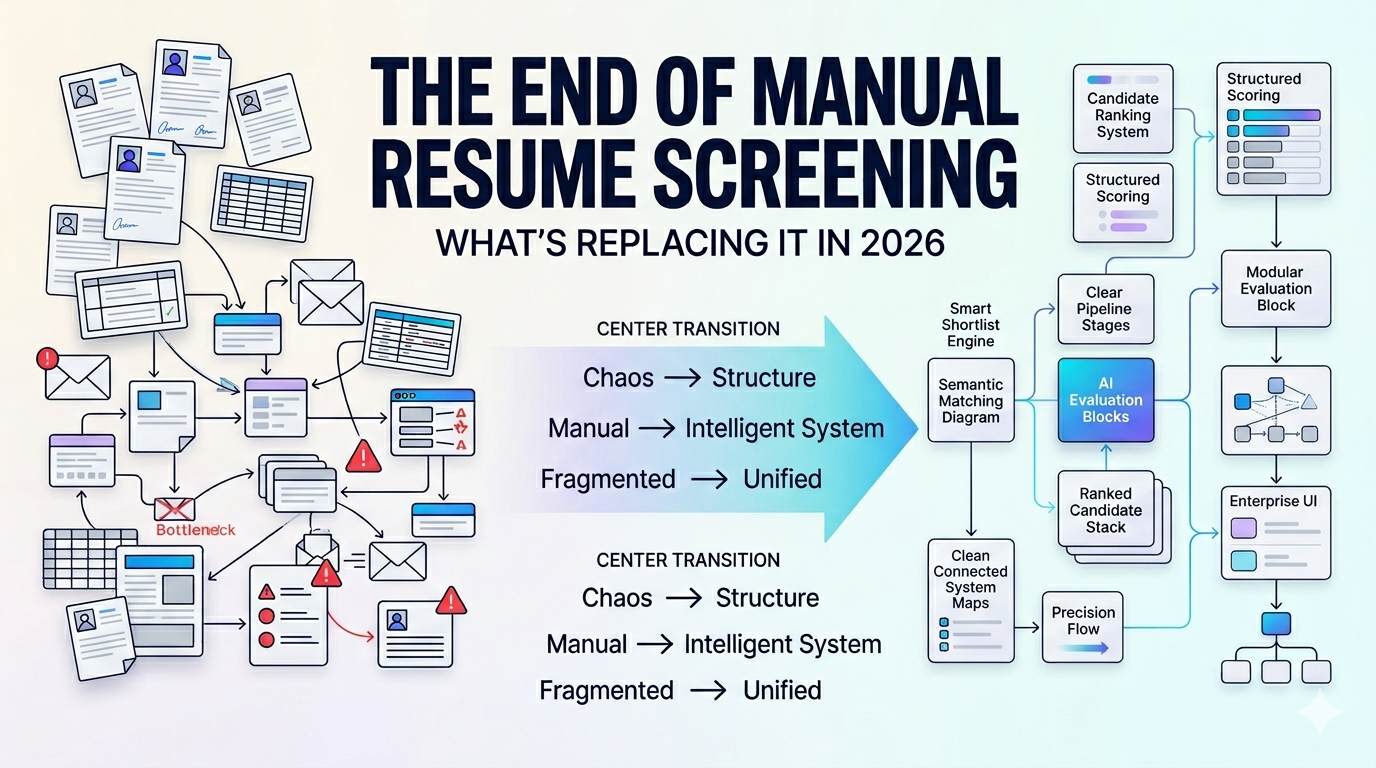
Asenior recruiter at a growing technology firm in Bangalore received 743 applications for a mid-level product role. She spent three days reviewing them. By the end, she had a shortlist of twelve candidates she was confident in.
Of those twelve, nine were rejected by the hiring manager as “not what we’re looking for.”
Three days. Seven hundred and forty-three resumes. And a shortlist with a 25% success rate.
This is not an outlier story. It is the everyday operational reality of manual resume screening in 2026 inside recruitment agencies managing dozens of mandates, inside HR teams at scaling companies, inside enterprise talent functions processing thousands of applications a month.
The question is no longer whether manual resume screening is broken. The question is what is replacing it and how fast the transition needs to happen.
Why Manual Resume Screening Is Collapsing Under Its Own Weight
Manual resume screening was designed for a different era. When a role attracted 50 to 100 applicants, a trained recruiter could apply genuine judgment across the full pool. That world no longer exists.
250+ average applications per corporate job opening in 2025, up from 98 in 2019 by Ashby Benchmark Report 2024
23 hours average recruiter time spent screening resumes per hire most on unqualified applicants by HireVue Research
6–8 seconds average time a recruiter spends on initial resume review at high volume by Ladders Eye-Tracking Study
72 hours window within which 50% of all applications on a post arrive, regardless of recruiter readiness by LinkedIn Talent Solutions 2024
Signs Your Hiring System Is No Longer Scalable
Recruiters manually reviewing hundreds of resumes per role
Shortlists changing drastically depending on the reviewer
Delays between application and first response
Qualified candidates disappearing before interviews happen
Recruiter burnout increasing with every hiring cycle
This is not a recruiter performance issue.
It is a systems design issue.
What Is Replacing Manual Resume Screening?
The replacement is not simply “AI hiring.”
It is structured, AI-assisted evaluation.
High-performing recruitment teams are moving toward a new hiring architecture:
Old model:
Human reviews every resume manually.
New model:
· AI evaluates applicants against predefined competency criteria
· Produces ranked shortlist
· Human reviewers make contextual decisions.
The difference is critical.
The best AI screening systems are not faster keyword scanners.
They are structured evaluation systems designed to apply the same criteria consistently across every candidate.
The Hidden Cost: Poor Screening Quality, Not Just Poor Screening Speed
The conversation about manual resume screening usually focuses on speed. The more important conversation is about quality. Because the two failures compound each other.
Bias Enters the Process Invisibly
•Research from MIT and the National Bureau of Economic Research found that identical resumes with different names one perceived as white, one as Black received 50% more callbacks for the white-sounding name
•A 2024 study found that 33% of recruiters admit that candidate name, location, or educational institution influenced their shortlisting decision, even when these factors were irrelevant to role requirements by Deloitte Global Human Capital Trends 2024
Evaluation Criteria Shift Between Reviewers
•60%+ of hiring managers admit final hiring decisions are influenced by gut feeling rather than structured evaluation by World Economic Forum and Future of Jobs Report
•Structured interviews predict job performance nearly twice as accurately as unstructured ones and structured screening produces similarly superior shortlists by Harvard Business Review
The Business Cost Is Real and Measurable
•A bad hire costs organisations an estimated 50–150% of annual salary in lost productivity, re-hiring costs, and onboarding waste by Deloitte Research 2024
•First-90-day attrition from poor role-fit is cited by 46% of hiring managers as the primary consequence of shortlist quality failure by LinkedIn Talent Solutions 2024
What Is Actually Replacing Manual Resume Screening in 2026
The shift happening across high-performing recruitment teams is not a technology swap. It is a process architecture change.
The underlying logic is different from both manual screening and ATS filtering:
·Old model: Human reviews every resume → applies inconsistent criteria → produces variable shortlist
·ATS model: Keywords filter applications → misses qualified candidates → produces keyword-optimised, not competency-optimised, shortlist
·New model: AI-structured screening → evaluates every applicant against pre-defined competency criteria → consistent, bias-reduced, ranked shortlist delivered to human reviewers for contextual judgment
The distinction matters. AI resume screening at its best is not faster keyword matching. It is structured competency evaluation at volume. Every candidate assessed against the same rubric. Every decision traceable to defined criteria. Every shortlist ranked by role-fit, not pattern familiarity.
What High-Performing Recruitment Teams Are Doing Differently Right Now
The transition away from manual resume screening is not happening all at once. The most effective implementations are staged and deliberate:
1. Define competency criteria before the post goes live
2. Deploy AI screening as the first-round layer, not the final decision. reviewers.
3. Measure quality outcomes, not just speed
4. Audit the screening rubric regularly.
5. Communicate transparently with candidates.
The operational gap that platforms like InterviewGod are designed to close is precise: the window between application received and qualified shortlist delivered.
When 600 applications arrive over five days, the question is not whether every resume can be manually reviewed with care. It cannot.
The question is whether your system can identify the right 80 candidates before your best applicants disappear to faster-moving competitors.
AI-structured interview screening gives every applicant an immediate, standardised evaluation experience and gives recruiters a criteria-matched, ranked shortlist instead of an inbox full of PDFs. The time saved is not just operational efficiency. It is the time that gets reinvested into the parts of hiring that genuinely require human judgment: relationship-building, contextual assessment, and offer negotiation.
The Shift Has Already Started
The end of manual resume screening is not a prediction. It is a transition already in progress.
The recruitment teams adapting fastest are not simply automating hiring. They are redesigning how candidate evaluation works at scale reducing recruiter overload, improving shortlist quality, and moving before top candidates disappear from the market.
Because in high-volume hiring, the biggest competitive advantage is no longer access to applicants.
It is the ability to identify the right candidates before everyone else does.
The companies winning hiring speed in 2026 are not reviewing more resumes. They are running better evaluation systems.
See how InterviewGod perationalizes that shift.
Leeza
InterviewGod