Why Your ATS Can Track Candidates but Can't Tell You Who to Hire
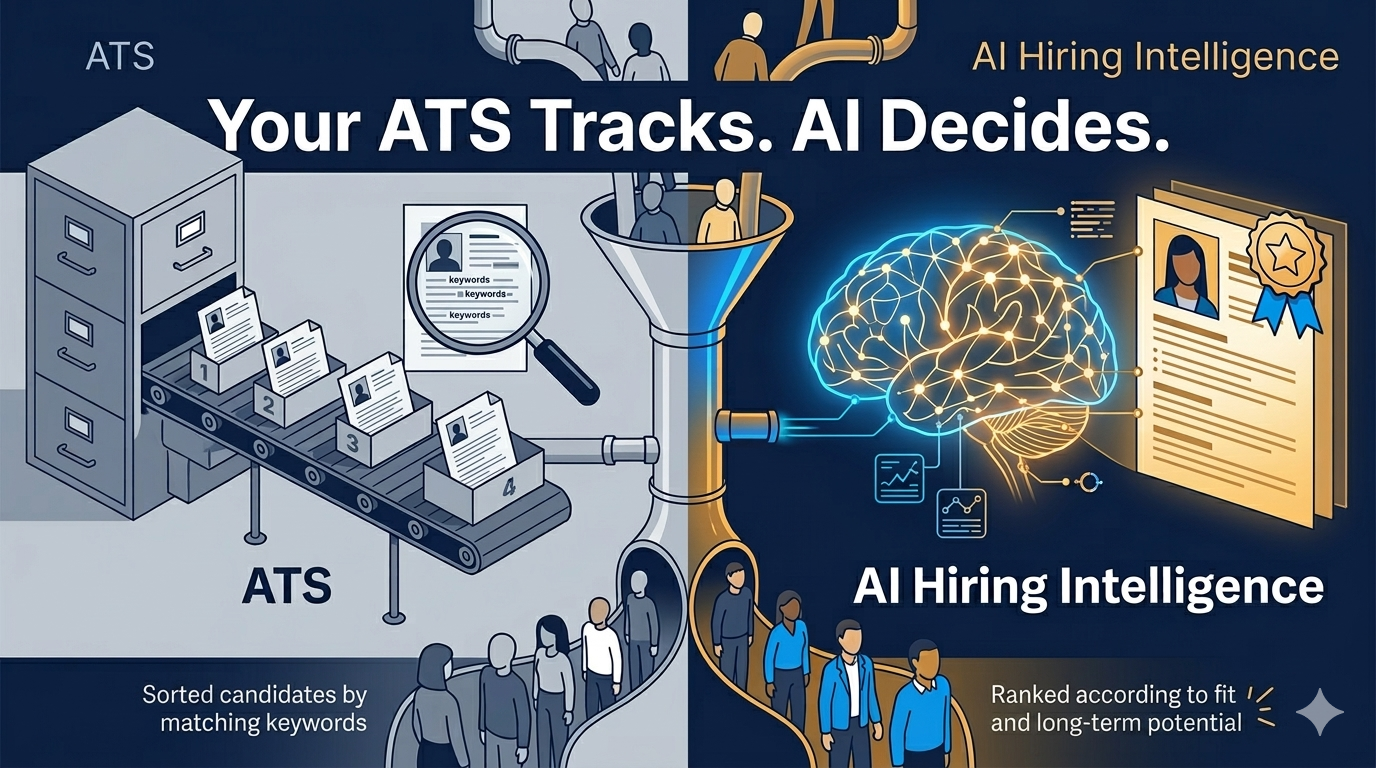
You have an ATS. Pipelines are full. Resumes are flowing in. But when it comes to making the actual hiring decision you are still guessing.
According to LinkedIn Global Talent Trends report, 76% of hiring managers say attracting the right candidates remains their biggest challenge even with an ATS in place. The applicant tracking system solves a workflow problem. It does not solve a decision problem.
Most hiring teams mistake pipeline activity for hiring progress. But a full pipeline means nothing if the best candidates are buried inside it.
And as hiring volumes continue increasing in 2026 and beyond, companies relying only on ATS workflows will struggle to compete with teams using AI-powered hiring intelligence.
This becomes even more critical in high-volume hiring environments, where recruiters are expected to process hundreds of applications without slowing down hiring speed or sacrificing candidate quality.
This blog breaks down exactly what an ATS does well, where it falls short, and why AI hiring software is emerging as the missing intelligence layer in modern recruitment.
What an ATS Actually Does
An ATS is fundamentally a workflow management tool. It was built to solve a logistics problem handling hundreds or thousands of job applications without losing track of them.
Here is what an ATS is genuinely good at:
• Collecting and storing resumes in one place
• Moving candidates through pipeline stages (Applied → Screened → Interviewed → Offered)
• Sending automated emails and status updates
• Filtering resumes by keywords, job titles, or education
• Keeping hiring teams aligned on where each candidate stands
These are real, valuable features. But they all answer one question: Where is this candidate in the process?
None of them answer the harder question: Should we hire this person?
Why ATS Systems Fail at Candidate Evaluation
The ATS was never designed to assess candidate quality it was designed to track candidate movement. That distinction matters enormously.
Here is where most ATS tools fall short when it comes to candidate evaluation:
• Keyword matching is not skill matching. A resume that mentions “sales” is not the same as a candidate who can sell. ATS filters surface keyword density, not contextual fit which is one of the core limitations of ATS systems.
• Stage-based data tells you nothing about hiring outcomes. Knowing that 40 candidates reached the interview stage does not tell you which 3 were actually worth hiring.
• Bias is built into the filter logic. If your ATS filters by degree, previous job title, or specific company names, it systematically screens out non-traditional but qualified candidates.
• High-volume pipelines create false confidence. A full pipeline feels productive. But recruiter bandwidth is still being spent manually reviewing candidates the ATS should have ranked intelligently. This problem becomes even worse in high-volume hiring environments where recruiters manage hundreds of applicants simultaneously.
According to LinkedIn Global Talent Trends report, 76% of hiring managers admit that attracting the right candidates is their biggest challenge even with ATS in place.
ATS vs AI Recruiting: What Is the Real Difference?
This is where the ATS vs AI recruiting comparison becomes clear. Both tools work with candidate data but they do fundamentally different things with it.
ATS (Applicant Tracking System) | AI Hiring Intelligence Tool |
· Tracks application stages | · Evaluates candidate quality |
· Stores resumes & data | · Analyses skills, fit & potential |
· Manages recruiter workflows | · Flags top candidates automatically |
· Sends status emails | · Predicts hiring success |
· Sorts by keywords | · Scores contextual relevance |
· Can miss qualified candidates | · Reduces bias in shortlisting |
· Answers: Where is the candidate? | · Answers: Should we hire this candidate? |
The ATS manages the funnel. The AI hiring software helps you decide who moves through it and who should get the offer.
How AI Hiring Tools Improve Candidate Evaluation
AI hiring software is not a replacement for your ATS. It is the decision layer your ATS is missing.
Here is what the better AI hiring software tools do differently:
• Score candidates on contextual relevance not just keyword presence. A candidate with 4 years of growth marketing experience at a Series A startup may be a stronger fit than someone with 8 years at a large corporate, depending on your role.
• Rank applicants automatically so your team is not spending 6 hours reviewing 200 resumes. You open the tool, see your top 10, and move fast. This is especially valuable for teams struggling with manual resume screening and delayed shortlisting.
• Identify patterns in your best hires and apply those patterns to new applicants. Over time, AI recruitment intelligence learns what “good” looks like for your company.
• Reduce bias in shortlisting by evaluating structured criteria rather than gut instinct or familiarity.
The modern hiring problem is no longer access to talent. It is decision-making at scale.
A 2022 SHRM study found that companies using AI in recruitment reported a 35% reduction in time-to-hire and significantly improved quality of shortlisted candidates.
Key Takeaways
• ATS platforms are built for workflow tracking, not candidate evaluation
• Keyword filtering often misses strong candidates with contextual fit
• AI hiring software helps recruiters rank, assess, and shortlist candidates faster
• Combining ATS systems with AI candidate evaluation improves hiring speed and quality
• High-volume hiring requires decision intelligence, not just application management
Do You Still Need an ATS?
Yes absolutely. The ATS is not the problem. The problem is treating it as a hiring intelligence tool when it was never built to be one.
Think of it this way:
• Your ATS is your filing cabinet and workflow manager
• Your AI hiring tool is your senior recruiter's instinct at scale
Used together, they cover the full hiring process: from application intake all the way to confident, data-backed decisions.
The Bottom Line
If your ATS could tell you who to hire, you would not still be spending hours on manual screening. You would not be losing great candidates to slow processes. And you would not be making gut-call decisions under pressure.
The gap between tracking candidates and knowing who to hire is real and it is widening as hiring volumes increase.
AI hiring intelligence does not replace your process. It makes your process actually work.
Your ATS tracks applicants. But hiring decisions require deeper intelligence than pipeline management alone.
See how InterviewGod helps hiring teams identify top candidates faster with AI-powered resume screening, interview intelligence, and automated candidate evaluation without increasing recruiter workload
Leeza
InterviewGod