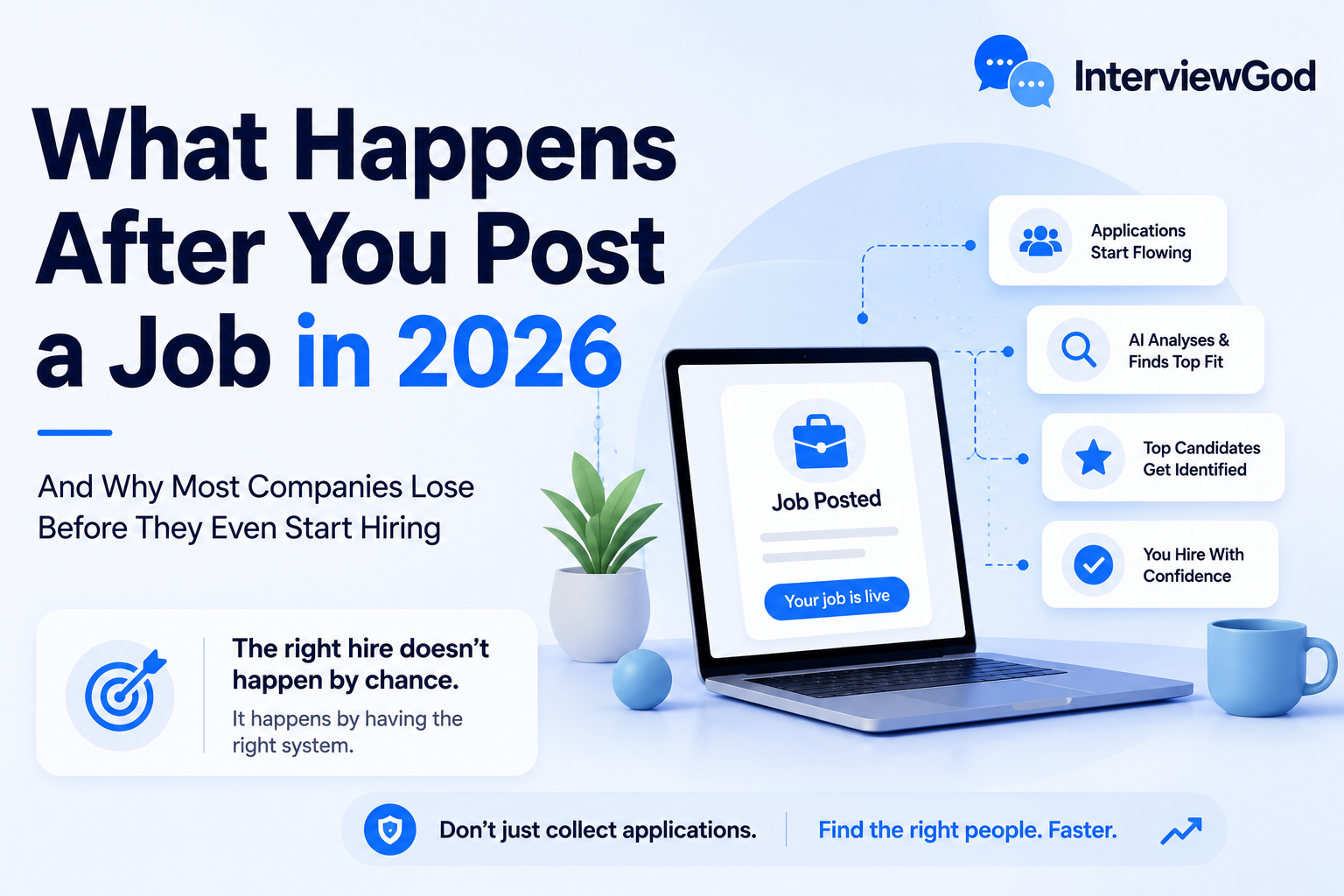
What Happens After You Post a Job in 2026 And Why Most Companies Lose Before They Even Start Hiring
Imagine a Talent Acquisition lead at a 300-person SaaS company managing five open roles with a two-person recruitment team. Applications are piling up faster than recruiters can evaluate them. The ATS tracks every applicant but it still cannot tell the team which candidates deserve immediate attention. Every morning starts the same way: an inbox that grew overnight, a shortlist that isn’t ready, and a hiring manager asking for an update.
You’ve written the job description. You’ve got sign-off from the hiring manager. You’ve posted it on LinkedIn, Naukri, or Indeed. And then you close the tab, thinking the hard part is done.
It isn’t.
Within 24 hours, the applications begin arriving. Within 48 hours, your inbox is a different problem entirely. Within a week, somewhere in that pile are three or four candidates who would have been exceptional fits and they’ve already moved on because your process wasn’t fast enough to hold their attention.
This is the hiring reality of 2026. And it is playing out inside recruitment agencies in Delhi and Mumbai, inside TA teams in London and Chicago, and inside scaling startups across Singapore and Jakarta every single day a job post goes live.
What Actually Happens in the First 72 Hours After a Job Post
The first three days after a job post goes live are the most operationally critical and the most chaotic. Here is what the data shows actually happens:
According to LinkedIn Talent Solutions research, nearly 50% of all job applications arrive within the first 72 hours of a role going live.
According to benchmark data from Greenhouse and Ashby, the average corporate job opening now receives 250+ applications in 2024, compared to just 98 applications in 2019.
Research from SHRM and CareerBuilder found that 65% of job seekers abandon an application process if it takes longer than 15 minutes, often before recruiters even review their profile.
The volume is not spread evenly across days. It hits fast. And most recruitment teams are not structured to process it at the speed required to retain the best applicants in that early window.
The Five Things That Go Wrong After Every Job Post
1. The Inbox Overwhelm
The first failure point is volume. Platforms like LinkedIn Easy Apply and Naukri Quick Apply have reduced the effort per application to essentially zero. The downstream effect is predictable: more applicants, more noise, more time lost to filtering before any real evaluation begins.
A single mid-level role in India now routinely attracts 500–1,200 applications within five days of posting
Enterprise roles in the US and UK average 250–400 applicants per post, with the number rising year-on-year
Recruiters spend an average of 23 hours reviewing resumes per hire most of it on unqualified applicants
2. The Candidate Drop-Off You Don’t See
Here is the part that rarely appears in pipeline reports: the best candidates are not waiting for you.
According to LinkedIn Talent Insights data, the average candidate actively applies to 7–10 roles simultaneously during a job search in 2026.
According to benchmark research from Ashby, top-performing candidates in competitive hiring markets typically receive an offer within 10 days of starting their job search.
According to response-rate and hiring-speed research from CareerBuilder and recruiting benchmark studies by ICIMS, companies that take longer than 5–7 business days to respond to applicant risk losing 30–40% of their strongest candidates to faster-moving competitors.
Candidate drop-off is the silent cost of slow hiring. It does not show up on a dashboard. It shows up when your shortlist is weaker than it should be, and no one can explain why.
3. The Screening Bottleneck
Assuming the applications arrive and the candidates are still engaged; the next failure is in screening velocity.
According to eye-tracking research conducted by Ladders and supported by recruiting workflow studies from SHRM, recruiters spend an average of just 6–8 seconds reviewing a resume initially, making high-volume manual screening heavily dependent on rapid pattern recognition rather than deep candidate evaluation.
According to research published by the World Economic Forum, more than 60% of hiring managers admit final hiring decisions are still influenced by gut feeling rather than structured evaluation criteria.
According to benchmark hiring data from Ashby in 2024, the average time-to-shortlist across industries ranges between 5–8 business days, during which many qualified candidates have already accepted competing offers elsewhere.
4. The Scheduling Chaos
Once a shortlist is built, the next breakdown is coordination. Interview scheduling across time zones, hiring manager calendars, and candidate availability is a known operational drain:
According to scheduling workflow data from Calendly in 2024, scheduling a single interview manually involves an average of 8–12 back-and-forth email exchanges between recruiters, candidates, and hiring managers.
According to recruitment operations benchmark studies from SHRM and hiring workflow research by Lever, manual interview coordination can add an estimated 3–5 days to the hiring cycle per interview round for teams operating without scheduling automation.
According to the Greenhouse State of Hiring 2024 report, every additional stage of hiring delay increases the risk of candidate withdrawal by approximately 15–25%, particularly in competitive hiring markets
5. The Evaluation Inconsistency
Even when candidates do make it through, the evaluation layer is often the weakest link.
When multiple interviewers assess candidates without a shared rubric, inter-rater reliability drops significantly meaning shortlist quality is partly a function of who reviewed the application, not how good the applicant was
Structured interviews predict job performance nearly twice as accurately as unstructured ones
First-90-day attrition from poor role-fit costs organisations 50–150% of the annual salary of the mis-hired employee
Why This Is Getting Worse, Not Better, in 2026
The forces driving these problems are structural and accelerating:
Easy-apply adoption is still growing. LinkedIn’s Easy Apply, Naukri’s Quick Apply, and similar features continue to lower the effort-per-application, pushing volumes higher each year
Remote and hybrid work expanded candidate pools globally. A role in Bangalore now attracts applications from across India. A role in London attracts EU-wide applicants. More reach means more noise
Candidate expectations are rising simultaneously. The same talent that produces 1,000-application inflows also expects faster, more personalised communication a direct tension with manual process capacity
Recruiter headcount has not kept pace. According to Gartner’s 2024 HR Survey, 45% of HR teams report operating below capacity relative to their hiring mandate
38 days average time-to-hire across industries in 2025–26, up from 28 days in 2021 by Ashby Benchmark Report 2024
58% of HR teams cite recruiter burnout as a top-three operational challenge in high-volume hiring environments by SHRM Talent Acquisition Survey 2024
What High-Performing Hiring Teams Are Doing Differently
The teams managing post-job-post chaos most effectively in 2026 share a common structural approach. They have separated the volume management problem from the evaluation problem.
They automate the first screening layer. Rather than manually reviewing every application, they deploy structured AI-assisted screening that evaluates all candidates against pre-defined competency criteria and surfaces the top 15–20% for human review. This alone reduces time-to-shortlist from 5–8 days to under 24 hours in documented deployments
They define evaluation criteria before the post goes live. The job description and the evaluation rubric are built together. Every screener, every AI system, every human interviewer works from the same criteria from the moment the post is published
They compress first-response time. Automated acknowledgment, structured async video screening, or AI interview tools deployed immediately after application ensure candidates receive engagement within hours, not days the single most effective lever for reducing candidate drop-off
They measure quality, not just speed. Shortlist quality, hiring manager satisfaction score, and 90-day retention are tracked from day one. Speed metrics alone mask the cost of bad hires
They eliminate scheduling friction in early rounds. Self-scheduling tools and async AI interviews remove the 8–12-email coordination cycle from first-round screening entirely
Where AI Hiring Tools Become Operationally Essential
This is precisely the operational gap that platforms like InterviewGod are built to address.
When a job post goes live and 400 applications arrive over the next five days, the question is not whether you can review them all. You cannot. The question is whether your system can identify the right 50 before your best candidates disappear.
AI-powered structured interview screening gives every applicant an equal, immediate, structured evaluation experience and gives recruiters a ranked, criteria-matched shortlist instead of an inbox.
The result: faster shortlists, better candidate retention, more consistent evaluation quality, and recruiters who spend their time on the part of hiring that actually requires human judgment.
It is worth noting that many AI recruitment tools still function as upgraded filtering systems. They automate resume parsing but fail to evaluate structured candidate performance across interviews, communication quality, contextual experience, and role-specific competencies. The next evolution of hiring intelligence is not automation alone it is decision-quality improvement at every stage of the post-posting process.
Three Things to Change Before Your Next Job Post Goes Live
Define your screening criteria before you publish. Know the three to five competencies you will evaluate every candidate against. Build this into your screening system before the first application arrives
Deploy a first-response system that works at volume. Whether that is an automated acknowledgment, a structured async interview, or an AI screening layer candidates should hear from you within 24 hours of applying
Measure post-performance. Track time-to-shortlist, candidate withdrawal rate, and shortlist-to-offer conversion. These three metrics will tell you exactly where your post-posting process is breaking down
The Uncomfortable Truth About Job Posting in 2026
Posting a job has never been easier. What happens after you post has never been more operationally complex.
The companies winning on hiring quality in 2026 are not the ones with the best job descriptions. They are the ones with the fastest, most structured, most consistent post-posting processes. They respond faster. They screen smarter. They evaluate consistently. And they lose fewer good candidates to their own process friction.
The job post is not the beginning of hiring. It is the beginning of the race. The question is whether your process is built to win it.
On Monday morning the recruiter staring at 1,247 applications does not need another dashboard. They do not need another spreadsheet, another status update, or another manual screening cycle. They need a hiring system capable of identifying the right candidates before the market moves on without them. Because in modern recruitment, the biggest hiring risk is no longer lack of applicants. It is losing qualified candidates inside slow, overloaded processes that were never designed for today’s hiring volume.
See how InterviewGod helps recruitment teams respond faster, screen smarter, and shortlist better from the moment a job post goes live.
Leeza
InterviewGod