Too Many Applications, Too Little Time: How to Handle High-Volume Hiring
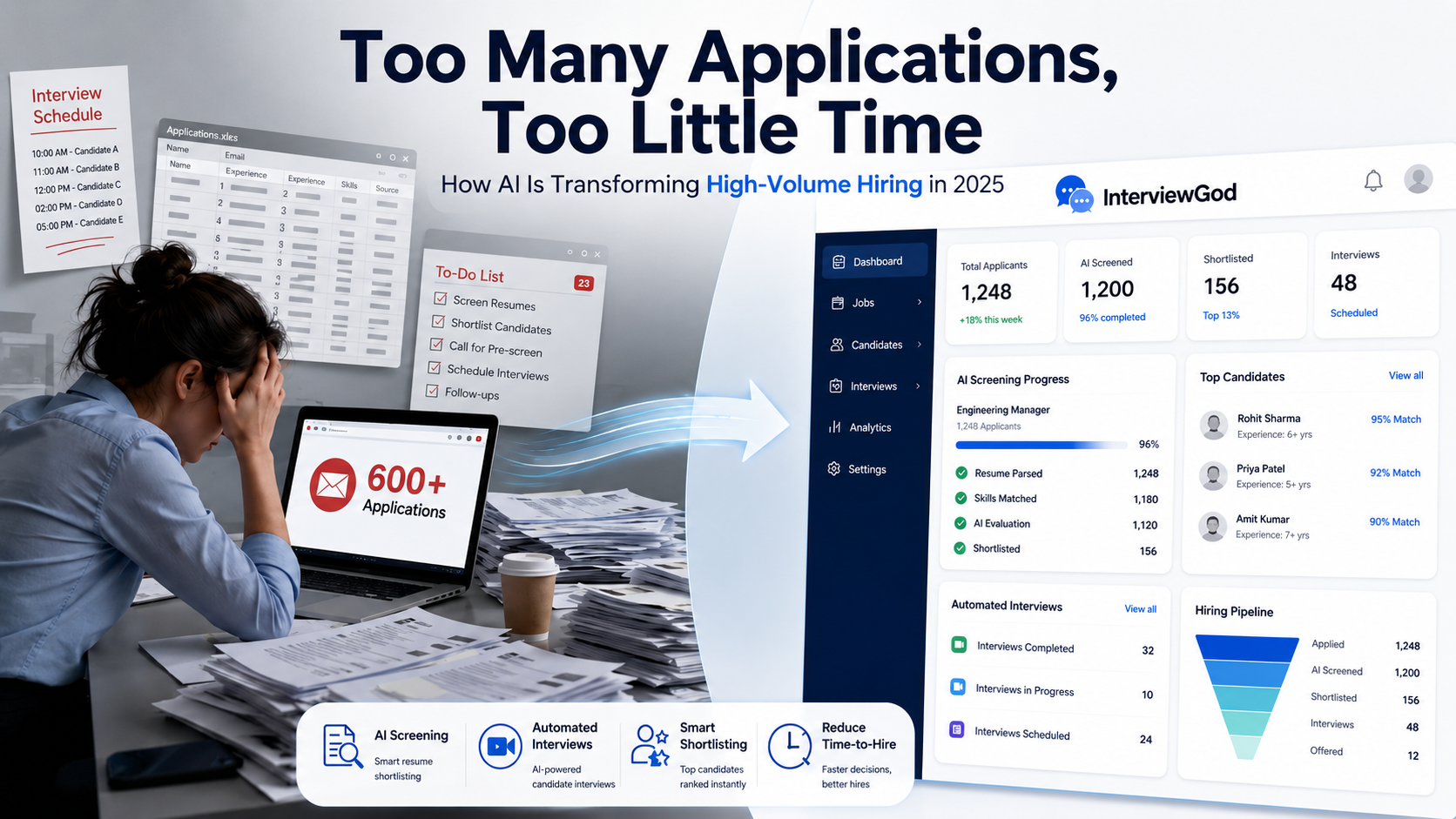
High-volume hiring can be handled efficiently by automating resume screening, prioritizing candidates based on skills instead of keywords, reducing manual interview coordination, and using structured evaluation systems. These steps significantly reduce hiring time while improving candidate quality.
Your job post goes live on a Tuesday morning the busiest day for candidate activity across markets. Within 24 hours, your inbox is flooded with 600+ applications. By the end of the week, only a fraction has been reviewed, and your best candidates are already off the market.
You haven’t made a hire. You’ve lost two weeks. And the role is still open.
This isn’t a failure of effort your team is doing the work. It’s a failure of the hiring system itself. And in 2025, this problem is accelerating application volume is rising, but hiring capacity isn’t.
What is High-Volume Hiring?
High-volume hiring refers to situations where recruiters need to process hundreds or even thousands of applications for a single role or across multiple roles simultaneously.
This is common in:
• Recruitment agencies handling multiple clients
• Startups scaling rapidly
• Enterprises with continuous hiring pipelines
Who Is Most Affected by High-Volume Hiring Challenges?
Before diagnosing the system, it is worth being precise about who experiences this the most because the pain looks different depending on where you sit.
If you run a recruitment agency, you are typically managing multiple active roles simultaneously, often for different clients, each role pulling 500 to 1,000 or more resumes. Your clients want shortlists in 48 hours. Your team of five cannot physically read 4,000 resumes across eight roles in that window. The math is structurally impossible without automation.
If you are an HR head or talent acquisition lead inside a scaling startup or enterprise, your challenge is different but equally severe. You are hiring aggressively perhaps 10 to 30 positions open at once while your recruiter headcount has not kept pace with that growth. According to Gem’s 2025 Recruiting Benchmarks Report, based on data from over 140 million applications, the average recruiter today manages 56% more open positions and 2.7 times more applications than they did three years ago, while recruiter team sizes have dropped from 31 to 24 per team since 2022.
More roles. More applications. Fewer people. No scalable, system-level solution. That is the equation most hiring teams are living inside right now in India, in the US, in the UK, and across Southeast Asia.
Why High-Volume Hiring Is Increasing in 2025
The volume surge is not a temporary spike. It is the result of several structural forces converging simultaneously, and understanding them is essential to understanding why old solutions no longer apply.
This is where the system begins to break.
Remote and hybrid work expanded the applicant pool globally. According to LinkedIn data cited in a 2025 ERE column, remote and hybrid roles account for just 20% of job postings but attract 60% of all applications. A role that used to receive 100 local applicants now pulls from an international pool multiplying volume without multiplying your team’s capacity.
Easy-apply platforms removed friction from the candidate side entirely. When submitting an application takes two clicks, the bar to apply drops dramatically and the signal-to-noise ratio in your inbox drops with it.
Application volume per hire has reached historically elevated levels. According to Ashby 2026 Talent Trends Report, applications per hire tripled from 2021 to 2024 and remained above 300 throughout 2025, with the average recruiter processing 291 applications per hire compared to roughly 100 in early 2021.
India, specifically, is accelerating faster than most markets. The country’s startup ecosystem is expanding rapidly, government AI investment is at an all-time high, and two-thirds of companies operating in India see a need to tap into more diverse talent pools to fill emerging roles far above the global average of 47%, according to the World Economic Forum’s Future of Jobs Report 2025. More companies competing for the same talent means more job posts, more applications per role, and a narrower window to move on the best candidates before they’re gone.
The geography matters because hiring behaviour varies. In India, recruitment agencies face extreme volume compression client expectations are high, turnaround windows are tight, and the applicant pool is vast. In the US and UK, the challenge skews toward efficiency and cost agencies are under pressure to deliver more placements per recruiter without expanding headcount. In Southeast Asia, digital recruitment adoption is accelerating rapidly but tooling remains fragmented. The common thread across all of these markets is the same: the volume of applications has outpaced the capacity of any manual system to handle it.
Why Traditional Hiring Breaks at Scale
Most hiring systems were designed for dozens of applications not hundreds. When volume increases:
• Resume screening becomes manual and slow
• Response time increases
• Top candidates drop off early
• Recruiter fatigue leads to inconsistent decisions
Why the Manual Process Fails Step by Step
Most agencies and HR teams’ default to a hiring workflow that was designed for a different era of application volume. Walk through it and the failure points become obvious.
A job post goes live. Applications arrive in an inbox or ATS. A recruiter reads each resume spending, according to research, between 30 and 90 seconds per resume during initial review, according to Vettio research on manual screening and recruiter burnout. They build a shortlist. They call each shortlisted candidate to check availability and do a pre-screen. They coordinate interview slots across multiple hiring managers. They run first rounds, second rounds, and final calls. They send an offer. They wait.
The time cost of this process is staggering. The average recruiter spends 23 hours screening resumes for a single hire, according to Eddy’s HR Encyclopedia. For an agency managing ten active roles simultaneously, that is 230 hours of screening work before a single substantive interview has taken place. A single high-volume role receiving 1,000 applications, reviewed at three minutes each, requires 3,000 minutes roughly 50 hours just to complete the first pass, according to ZYTHR analysis of recruiter burnout in high-volume roles.
And this is where most teams underestimate the problem.
Then comes the accuracy problem. When a recruiter makes hundreds of fit-or-no-fit judgments in a single day, cognitive load degrades the quality of each subsequent decision. 52% of hiring managers say they spend less than two minutes reviewing each resume, leading to rushed decisions and a higher chance of overlooking top talent, according to M&B Search Group’s hiring research. Your shortlist quality is being shaped by reviewer fatigue as much as by actual candidate quality which means you are potentially filtering out strong candidates and advancing weaker ones.
Then comes the speed problem, which is where the real business damage happens. The average time-to-hire has grown to approximately 42 days, driven by additional interview rounds, assessments, and stakeholder input, according to Hiring Thing 2025 Job Application Statistics report. But top candidates are not waiting 42 days. They are evaluating multiple offers simultaneously and making decisions in days. Every week your process adds to the timeline is a week in which your best candidates are receiving, considering, and accepting offers elsewhere.
The Real Cost of Slow Hiring Processes
Slow high-volume hiring carries costs that extend well beyond the recruiter’s desk.
•About 81% of recruiters in 2024 reported feeling burned out at work, and 43% cite repetitive tasks as the leading cause, according to Vettio burnout research. Burnout increases turnover on your own team, which compounds the problem further.
•Nearly 70% of HR professionals say they are dealing with heavier workloads than they were a year ago, and 1 in 3 HR leaders cite resume screening as one of their most time-consuming and energy-draining responsibilities, according to M&B Search Group.
•Recruiters spend an average of 78,352 minutes on the phone annually, much of it on unproductive initial screening calls that generate no decision-making value, according to research cited by daily.dev recruiter resources.
•For agencies specifically, slow shortlist delivery means client dissatisfaction, lost mandates, and reduced revenue all traceable back to a manual process that simply cannot match client expectations at scale.
How to Handle High-Volume Hiring Efficiently
To manage high-volume hiring effectively, companies need to:
• Automate resume screening
• Prioritize candidates based on skill signals, not keywords
• Reduce manual interview scheduling
• Use structured evaluation instead of gut-based decisions
Without these, hiring speed and quality both suffer.
Why ATS Tools, Manual Recruiters, and Job Portals Are Not the Answer
The market has offered several partial solutions to the volume problem. None of them address it completely.
Job portals (Naukri, LinkedIn, Indeed) solve the awareness problem they generate application volume. But they do not filter it. They make the inbox problem worse, not better. Job boards and social media generate 49% of all applications but contribute only 24.6% of actual hires, according to SalesSO 2026 recruitment statistics report a massive mismatch between volume generated and value delivered.
Manual recruiters are not scalable. Adding one recruiter to handle volume spikes means adding salary, benefits, and ramp-up time and losing that capacity the moment hiring slows. Scaling team size to match application volume is not a strategy; it is a cost spiral.
Traditional ATS platforms are tracking tools, not decision-making tools. They tell you where a candidate is in your pipeline. They do not screen candidates intelligently, assess them, or move them through the process without human input at every step. Only 45% of recruitment firms globally had implemented applicant tracking systems as of 2025, according to Business Research Insights’ Recruitment Market Report and the majority of those systems still require manual resume review as the primary screening step.
The gap that exists across all three of these categories is end-to-end automation the ability to take a raw application, screen it against defined criteria, conduct a structured first-round interview, and schedule next steps, all without requiring a human to touch it at each stage. This is not an incremental upgrade to existing tools. It is a different category of solution entirely.
The Shift: From Manual Effort to AI-Driven Hiring Systems
The move toward AI in recruitment is not a trend to watch. It is already happening at scale, and the performance gap between teams using AI and those relying on manual processes is measurable and growing.
•87% of companies now use AI tools in recruitment, with employers reporting 30% lower cost per hire and 25% faster time-to-hire on average, according to All About AI data cited in VIVA USA’s 2025 recruitment trends guide.
•In India specifically, recruiters now allocate 70% of their recruitment budgets to AI tools, with a clear focus on quality hiring outcomes, according to the Economic Times in 2025.
•AI screening tools currently achieve 89 to 94% accuracy rates, with resume parsing accuracy at 94% and skill matching at 89%, according to Second Talent’s AI recruitment statistics report for 2026.
•67% of businesses now use AI to handle large applicant volumes, and 66% of organizations that adopted AI have reduced their overall hiring costs, according to Apollo Technical 2025 statistics on AI in recruiting.
•India’s recruitment software market reached USD 80 million in 2024 and is projected to reach USD 120 million by 2033, driven by widespread adoption of AI-powered automation across enterprises and startups, according to IMARC Group India Recruitment Software Market Report.
The direction is clear and accelerating. Gartner’s recruitment technology research indicates that AI adoption in recruitment will reach 81% by 2027. Teams that have already automated their screening, interviewing, and scheduling functions are not just moving faster they are winning candidates that slower competitors are still scheduling initial calls with.
Where InterviewGod Changes the Equation
This is where AI-driven screening and automated interview platforms start to make a measurable impact reducing manual effort while improving consistency in evaluation.
InterviewGod is purpose-built to solve this. It is not an ATS. It is not a scheduling add-on. It is an end-to-end AI hiring automation platform built for agencies and HR teams operating at high volume teams that cannot afford to keep doing manually what a system can do intelligently.
Here is what the platform does and why each piece matters to your bottom line:
•AI resume screening automatically ranks and filters every application against your defined role criteria.Your team opens a curated, scored shortlist not a raw inbox of 800 unfiltered resumes. Screening consistency is maintained across every role, every reviewer, every day. The business outcome: the 23 hours per hire currently spent on manual screening is replaced by a structured list your team can act on immediately.
•Automated AI interviews give candidates a structured first-round interview they can complete on their own schedule video or text-based, evaluated against consistent criteria. Your team reviews AI-generated summaries and assessment highlights rather than raw recordings. The business outcome: first-round interview capacity scales to match application volume, regardless of how many roles are active simultaneously. You are no longer the bottleneck.
•Interview scheduling automation eliminates the back-and-forth that currently eats hours of recruiter time per role. Candidates self-book against live calendar availability. Confirmations and reminders go out automatically. The business outcome: the coordination overhead between shortlisting and the substantive interview is reduced from days to hours.
•Consistent, criteria-based evaluation means every candidate across every role is assessed against the same standards, in the same way. Bias from reviewer fatigue, day-to-day variation in judgment, and recency effects are removed from the screening process. The business outcome: shortlist quality becomes reliable and defensible not dependent on who happened to be reviewing resumes when the batch came in.
The transformation these four elements create together is not incremental it is structural. For a recruitment agency, it means delivering faster shortlists to more clients with the same team size increasing throughput without increasing cost. For an in-house HR team, it means your recruiters stop spending the majority of their week on screening and scheduling, and start spending it on the candidates who actually require human judgment.
Three Places to Start This Week
You do not need to overhaul your entire process overnight. The most effective approach is to identify your biggest bottleneck and eliminate it first.
•Measure your current time-to-shortlist. Count the days from when applications open to when a shortlist is ready for the hiring manager. If it is longer than five days for a high-volume role, the problem is structural not a matter of recruiter effort or speed.
•Define your screening criteria before you post. Write down the three to five non-negotiable qualifications for every active role before the applications open. This is the prerequisite for any AI screening to work correctly, and it forces clarity that improves evaluation quality regardless of what tool you use.
•Automate one step, measure it, then expand. Replace your first-pass resume review or your first-round interview scheduling with an AI tool. Track time saved and shortlist quality over 30 days. Use that data to build the internal case for automating additional steps.
The Competitive Window Is Narrow and Closing
AI recruiting investments grew 54% from 2022 to 2024, reaching $142.3 billion globally, according to Twinstrata data cited in Apollo Technical’s AI recruiting statistics report. The agencies and HR teams investing in AI-driven high-volume hiring systems now are not just solving a current problem they are building a structural advantage over competitors who are still reading resumes manually.
According to a 2023 LinkedIn Talent Solutions report, 76% of recruiters in India believe AI accelerates hiring by quickly identifying top candidates. The belief is widespread. The gap is in implementation. Most organizations know AI belongs in their hiring process. Far fewer have actually built a system around it.
That gap is your competitive window. It will not stay open indefinitely. The longer your hiring process stays manual, the more top candidates you lose to faster teams.
Stop losing top candidates to a slow pipeline. See how InterviewGod helps you screen resumes faster, reduce time-to-hire, and run high-volume hiring efficiently without increasing your team size
Visit: InterviewGod
Leeza
InterviewGod